 Nam
Nam
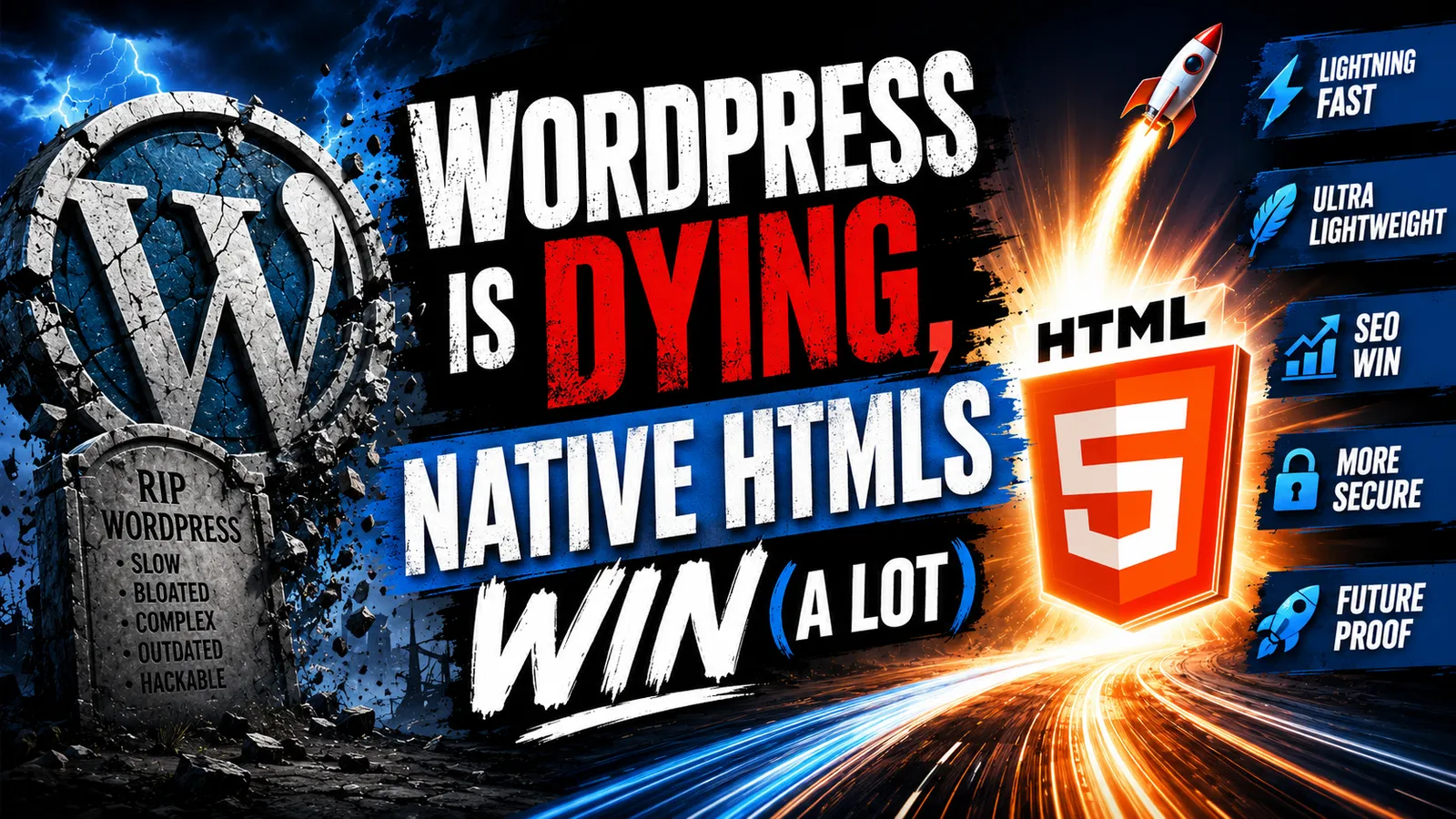
A friend sent me that thumbnail last week. “WordPress is DYING.” Gravestone, rocket, the works. It’s the kind of headline that’s engineered to make you angry enough to click — and I almost scrolled past it, because it’s wrong.
WordPress isn’t dying. It still runs roughly 42% of every website on earth. Something that large doesn’t die; there are more WordPress sites today than there were programmers alive a decade ago.
But “dying” and “healthy” aren’t the only two options. The honest word is decaying — slowly, unevenly, and fastest exactly where it hurts: with the developers who have to maintain it and the small businesses who quietly pay its taxes. I know because I spent last weekend tearing WordPress out of a site I care about a great deal — my wife’s — and the reasons I did map almost one-to-one onto why the wider web is drifting away from it.
Here’s the grounded version of that thumbnail, minus the gravestone.
Table of contents
Open Table of contents
”Dying” is wrong. “Decaying” is right.
Start with the number everyone argues about. By W3Techs’ tracking, WordPress fell from 43.2% of the web in December 2025 to 41.9% by late May 2026 — a 1.3-point drop in six months, roughly double what it lost across all of the previous year. The decline isn’t just happening; it’s accelerating, and no other major platform on the same chart is moving like that.
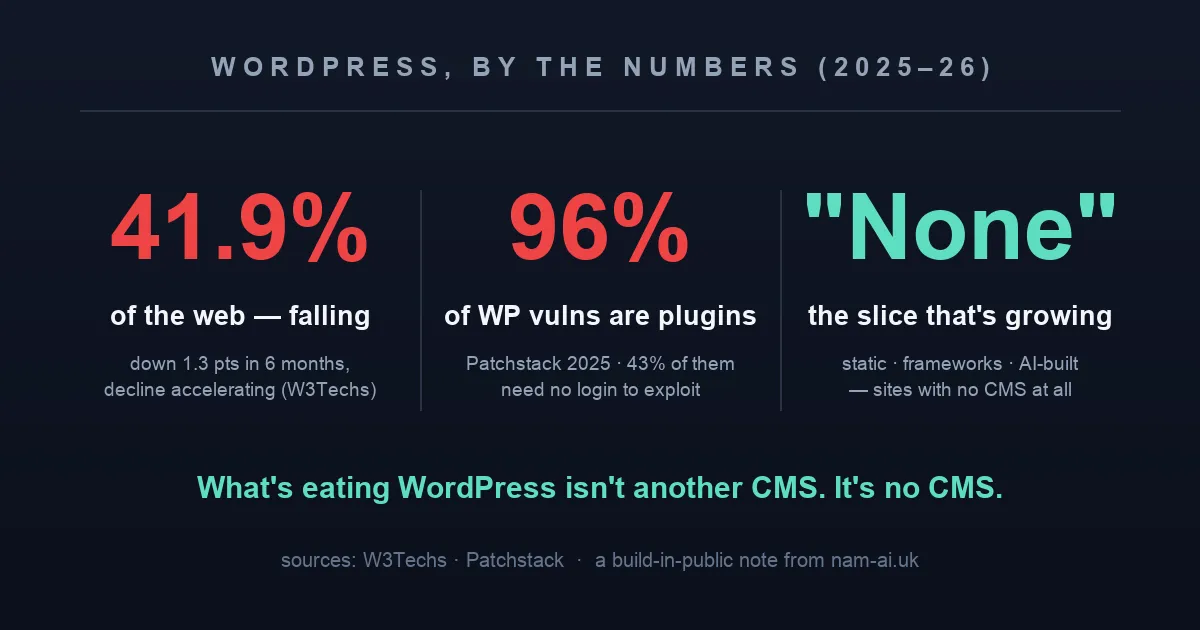
Three figures that tell the whole story. Sources: W3Techs, Patchstack.
But the share number isn’t even the interesting part. Look at who’s gaining. It isn’t Wix or Shopify or some rival CMS mounting a coup — they picked up a rounding error between them. The slice that actually grew is the one labelled “None”: sites with no detectable CMS at all. Static-site generators, front-end frameworks, hand-rolled HTML, and the new wave of AI-built sites that leave no WordPress fingerprint in the page source.
The thing eating WordPress isn’t another content-management system. It’s no content-management system. For a growing share of sites, the answer to “which CMS?” is turning into “we didn’t need one.”
And the leading indicator is worse than the installed base. WordPress’s share of newly built sites is running below its share of the web overall — old WordPress sites stay WordPress out of inertia, but fewer new projects reach for it. That gap is what decay looks like in slow motion: the back catalogue holds while the front door narrows.
Why developers are done with it
Ask a working developer about WordPress and you’ll rarely get neutrality. The notoriety has three distinct sources, and they’ve all gotten worse lately.
1. The bloat is structural, not sloppy. When I audited my wife’s site — a portfolio, not a shop — the homepage alone shipped 122 requests and 2.2 MB, including React, ReactDOM and lodash on every page, loaded by WooCommerce for a store with zero products. Plus Contact Form 7, for a site with zero forms. Nobody chose any of that. It’s what accumulates when a theme, a page builder, and a decade of plugins each quietly bring their own dependencies. WordPress’s plugin model is its superpower and its curse: every convenience arrives welded to code you didn’t write, can’t see, and now have to keep alive.
2. The security surface is the plugins — overwhelmingly. This is the part that turns eye-rolls into genuine wariness. Per Patchstack’s 2025 security research, 96% of new WordPress vulnerabilities live in plugins (about 4% in themes, and core itself is rarely the problem). Of 2024’s roughly 4,000+ new disclosures, the vast majority were plugin flaws — and around 43% required no authentication at all, which is exactly the profile automated bots hunt for at scale. You don’t run WordPress; you run WordPress plus fifteen third-party codebases of wildly varying quality, any one of which can be your breach. On my wife’s old site, that abstract risk had already become concrete: a plugin failure had been silently hiding 76 of her 85 events from every visitor for who knows how long — not a hack, just the plugin stack failing quietly, which is arguably worse because nobody gets an alert.
3. The governance broke the trust. For years, developers treated WordPress.org as neutral public infrastructure — the plumbing everyone builds on. Then in late 2024, in the Automattic–WP Engine dispute, that plumbing got weaponised: access to WordPress.org was cut off in a way that broke plugin and theme updates for hundreds of thousands of sites caught in the crossfire. In December 2025 a federal judge ordered access restored within 72 hours, but the damage to the mental model was done — a court had to intervene to keep the updates flowing. Add Automattic laying off ~16% of staff in 2025 and the lawsuit grinding on with no trial date, and the message a lot of developers absorbed was simple: the foundation I’ve been standing on has an owner, and the owner can pull the floor.
None of these are fatal on their own. Together they explain why “WordPress” has become a slightly dirty word in a lot of engineering rooms — and why so many new builds start with “not that.”
Why small businesses quietly suffer
Developers are loud about WordPress. Small and medium businesses are the ones actually paying for it, usually without a vocabulary for what’s wrong. Four taxes, all of which my wife was paying:
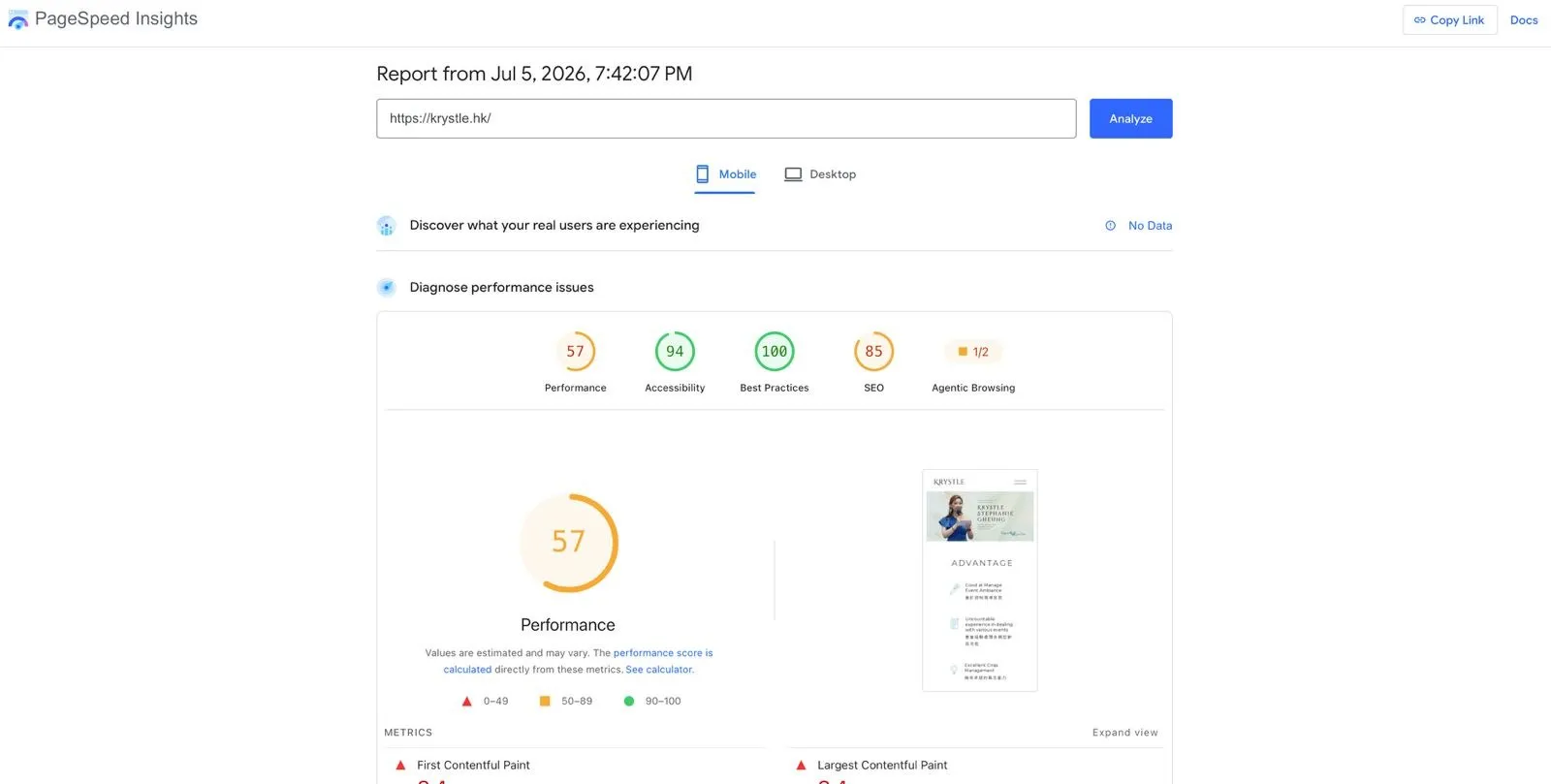
The old WordPress build, scored on the same test as everyone else’s site. This is what “it works fine” quietly costs you in 2026.
- The performance tax. Her portfolio scored 56 on Lighthouse with a 13.8-second largest paint. On mobile, that’s not “a bit slow” — that’s clients bouncing before her first photo loads, and Google noticing. Speed is a ranking and conversion factor now; a heavy WordPress stack spends that budget on plugins nobody’s using.
- The maintenance tax. WordPress is never done. Core updates, plugin updates, theme updates, PHP-version bumps, the security plugin, the backup plugin, the caching plugin to paper over the first three. For a business without an in-house developer, that’s either a monthly bill to an agency or a time bomb nobody’s watching.
- The “you still need a developer anyway” tax. WordPress is sold as the no-code option, but the moment something breaks — a plugin conflict, a white screen, a hacked footer — the small-business owner is right back to needing a specialist. The autonomy was partly an illusion; they were dependent all along, just on a more fragile stack.
- The bulk-editing tax — the one that actually pushed us over. As Krystle’s business grew, she needed fast, batch changes: recategorise a season of events, swap a block of photos, add ten bookings after a busy quarter. In Elementor, each of those was page after page of clicking — which is precisely why those edits kept not happening. A CMS built for editing one page at a time quietly punishes a business that’s growing in batches. For her, that friction mattered more than the load time.
A slow, plugin-heavy site rarely fails loudly. It just underperforms — a little worse in search, a little slower on mobile, a little more of the owner’s evening spent on updates, a little too painful to bulk-edit — and everyone calls it “fine” because nothing is technically broken. Decay is the accumulation of fine.
The Krystle case, in one paragraph
So I rebuilt it. My wife Krystle is a professional bilingual MC in Hong Kong; her site is how clients find her. One Sunday evening with an AI agent later, the WordPress + Elementor + heavy-theme stack became 102 pages of dependency-free static HTML — same design, same URLs, ~5 KB of JavaScript instead of ~700 KB. First paint went from 13.8 s to 1.7 s; Lighthouse SEO from 85 to 100; the silently-hidden-events bug became structurally impossible, because there’s no plugin left to fail. And the bulk edits she actually needs? Her events now live in JSON — a batch change is a search-and-replace and one build command, not an afternoon of clicking. The full teardown, the honest trade-offs, and the SEO scoreboard are a four-part series: Part I — the rebuild, Part II — the UI, Part III — the SEO, Part IV — the post-launch lessons.

The old portfolio. A failed “Load More” plugin call was hiding 76 of 85 events from every visitor — silent, un-alerted, and exactly the class of failure that disappears when the plugins do.
She isn’t a special case. She’s the typical case: a small business whose site slowly rotted under a stack built for a different job, until the friction got loud enough to fix.
When WordPress is still the right call
Here’s where I lose the clickbait crowd, because credibility matters more than a clean narrative: WordPress is often still the correct choice, and pretending otherwise is how you end up rebuilding a site that should’ve been left alone.
Static-from-data — the thing that replaced Krystle’s WordPress — is the right answer when a site’s content is structured and changes in batches: portfolios, brochures, menus, event lists, docs. It’s the wrong answer for:
- An owner who publishes daily and needs to self-edit. A blogger or news site that lives in the editor should not be filing a git commit to fix a typo. That’s what a CMS is for, and WordPress is a very good one.
- A site genuinely built on plugins. Real e-commerce, memberships, complex forms, booking systems with live inventory. WooCommerce exists for a reason; don’t hand-roll a checkout to save 40 KB.
- A team with no developer at all, ever. My wife’s rebuild works because her in-house developer shares a bed with her. Take that away and a managed WordPress host is a perfectly rational place to be.
The question was never “is WordPress bad?” It’s who edits this site, how often, and in what shape? Structured content that changes in batches, with a technical owner → leaving WordPress is a huge win. Freeform content that changes daily, with a non-technical owner → WordPress is still doing exactly the job it’s good at.
The takeaway
So, is WordPress dying? No — and anyone who tells you otherwise is selling a thumbnail. But is it decaying? Yes, measurably: share falling and accelerating, new projects choosing it less, a security story that’s really a plugin story, and a governance crisis that spooked the developers who kept the ecosystem alive.
The most interesting part is what’s replacing it — because it isn’t a rival CMS. It’s the “None” column: static sites, frameworks, and AI-built pages with no CMS at all. For years, “just build it in plain HTML” was impractical for a small business — too much developer time for too small a site. That maths just changed. An AI agent can now do the tedious 90% — crawl the old site, generate the images, stamp the pages, check the links — while a human keeps the taste and the judgement. Which means the lightweight, no-CMS option is finally viable at the small-business scale where WordPress used to win by default.
The gravestone in that thumbnail is theatre. But the rocket has a point: for a growing number of sites, the right answer really is less — and the tools to reach it are, for the first time, within reach of the people who need it most.
Sitting on a WordPress site that’s slower or more fragile than it should be, and not sure whether it’s worth rebuilding? That’s exactly the question I like — email me and I’ll give you an honest read.
If this was useful, there’s more where it came from: follow me on Medium, subscribe or bookmark nam-ai.uk for new posts on building and shipping with AI, and feel free to connect on LinkedIn — I’m always happy to talk shop.