 Nam
Nam
For about a decade, there was one universally correct answer to “where do I host this?” if you were a freelancer or a tiny team: get a $5 DigitalOcean droplet. It held a client’s WordPress site, a staging box, a side project, your VPN. The price never moved, the UI didn’t fight you, and whatever broke at 2am, there was a DigitalOcean community tutorial for it — usually the first Google result, usually better than the official docs of the thing you were fixing.
In 2026, when I ask the same crowd where their stuff runs, the answers are Hetzner, Vultr, Hostinger, a Coolify box, “some PaaS”. Almost nobody says DigitalOcean anymore.
Here’s the thing though: DigitalOcean didn’t collapse. Revenue just crossed $901 million, growing again after a long slide. What actually happened is quieter and more interesting — the company moved upmarket and left its original audience behind, one reasonable-sounding decision at a time. If you sell to freelancers, or you are one, the whole arc is worth studying, because the same playbook is coming for every tool you love.
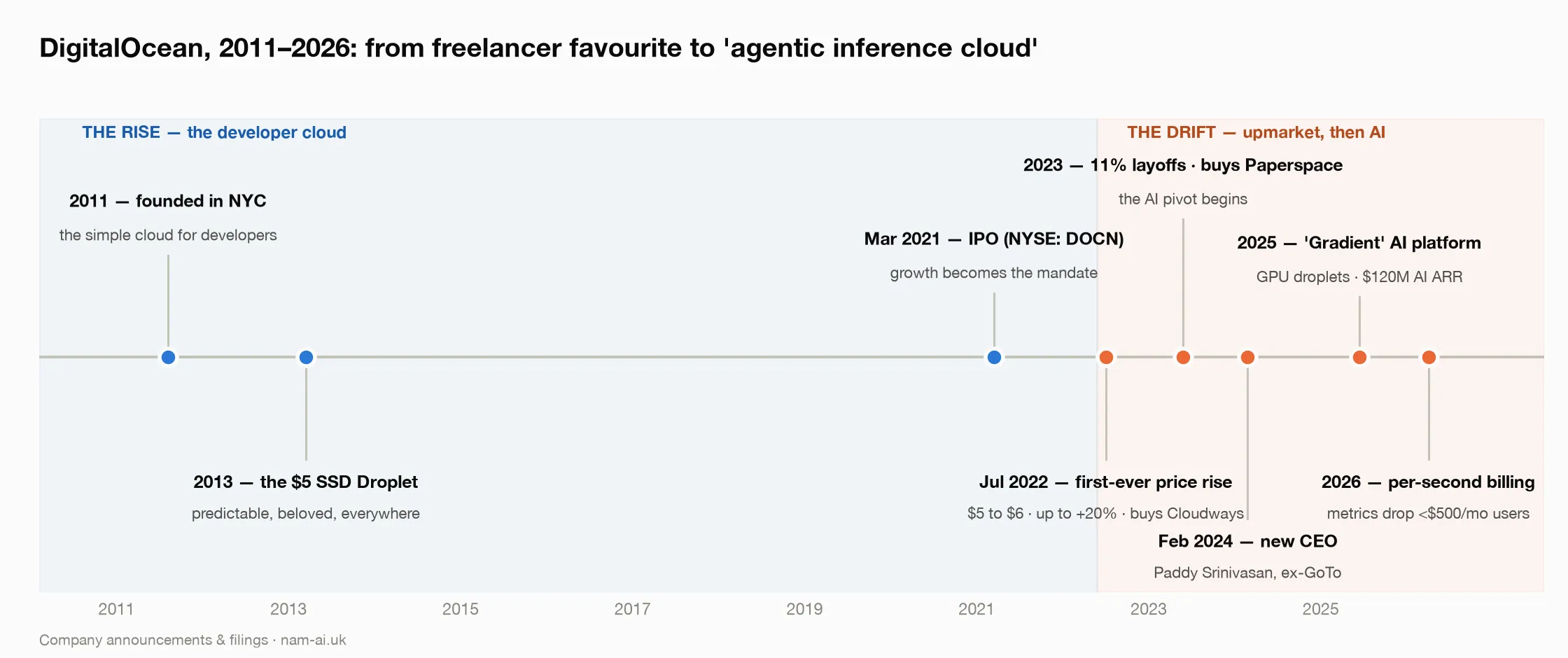
Fifteen years in one line: a decade of being the developer’s cloud, then four years of drifting toward bigger customers and, eventually, AI. Sources: company announcements and filings.
Table of contents
Open Table of contents
Why everyone loved it
DigitalOcean won the freelancer market around 2013 with a genuinely radical product: an SSD server for $5/month, flat. No calculator with forty inputs, no surprise line items, no “it depends” pricing page. The bill was boring, and for a solo dev invoicing clients, boring is exactly what a cost should be.
The moat wasn’t really the servers, though — it was the tutorials. DigitalOcean’s community docs taught a generation of us nginx, systemd, UFW, Postgres backups. Add Hacktoberfest and a clean control panel, and DO wasn’t just a host; it was where you learned to be the kind of person who runs servers. AWS sold to CTOs. DigitalOcean sold to the person doing the work.
That trust is why what came next stung.
The turn: July 2022
In March 2021 DigitalOcean IPO’d on the NYSE as DOCN — and a public company inherits a mandate: grow, every quarter, forever. Sixteen months later, in July 2022, came the first price increase in the company’s history: the beloved $5 droplet became $6, with rises of up to 20% across products, softened by a new cut-down $4 tier (512 MB — enough for a DNS resolver, not a client site).
A dollar is not an outrage; that’s not the point. The point is that “the price never moves” was the product, and now it moved. The psychological contract broke.
The clearer signal was what happened to support. Response times are now a paid product line:
| Plan | Price | First response |
|---|---|---|
| Starter | Free | < 24 h, email |
| Developer | $24/mo | < 8 h |
| Standard | $99/mo | < 2 h, + live chat |
| Premium | $999/mo | < 30 min, + Slack channel |
Read that middle row again: being answered within a working day costs $24/month — more than the server it supports. For a freelancer with a client site down, “free” means tomorrow. Nothing communicates “you are no longer the customer” quite like a support paywall priced above your entire monthly spend.
Follow the money
The financials tell the story without any editorializing:
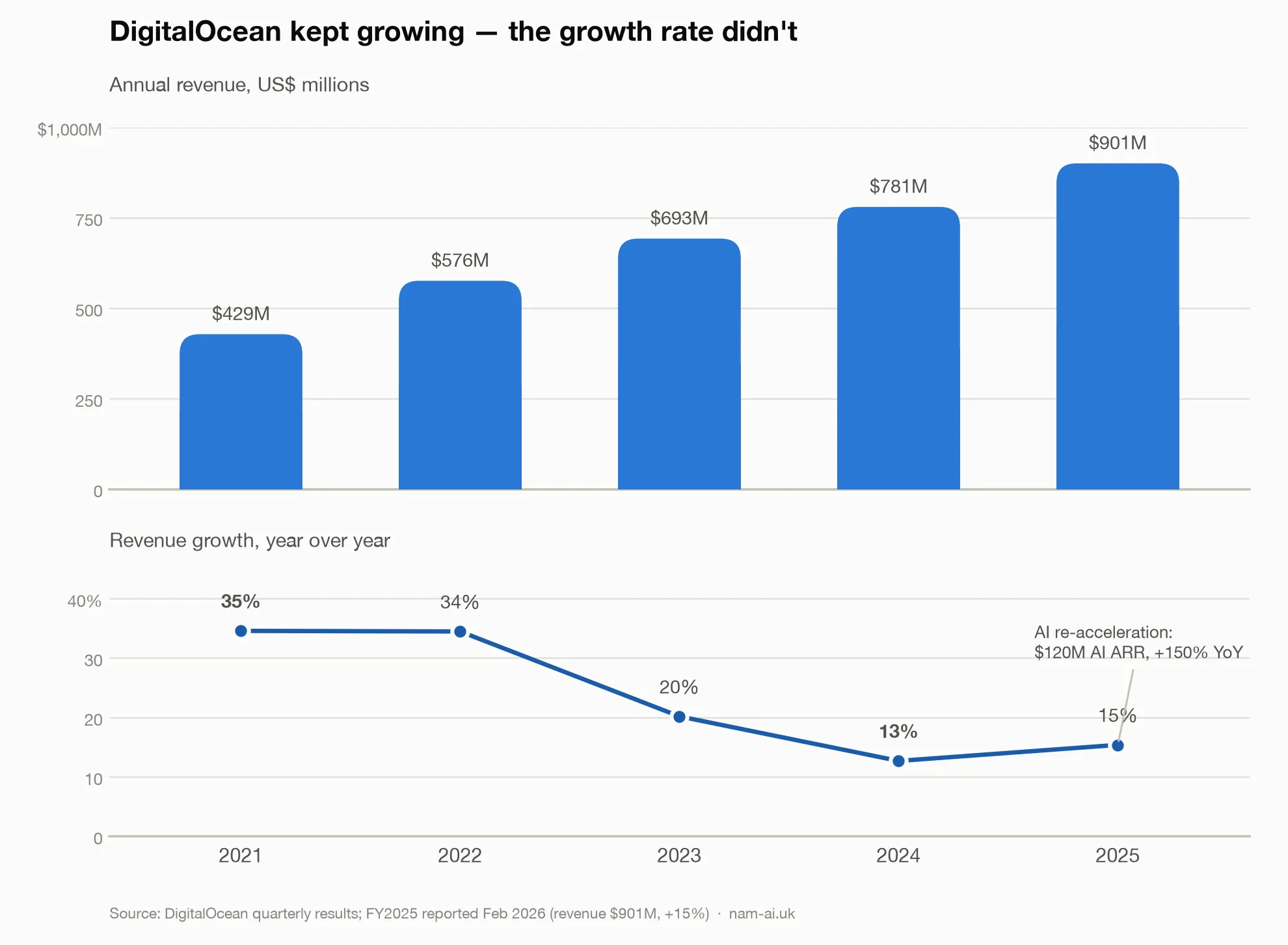
Revenue kept climbing, but growth cooled from 35% to 13% by 2024 — then AI money re-accelerated it. Source: DigitalOcean quarterly results; FY2025 reported February 2026.
Between the IPO and 2024: growth fell from ~35% to ~13%, the company cut about 11% of staff in February 2023, bought Cloudways ($350M, managed hosting) and Paperspace ($111M, GPU cloud), and in February 2024 brought in a new CEO, Paddy Srinivasan. The fix for slowing growth was never going to be more $6 droplets.
By 2025 the pivot had a name: Gradient, DigitalOcean’s “agentic inference cloud” — GPU droplets, model serving, agent tooling. And it’s working: FY2025 closed at $901M, +15%, with $120M of AI ARR growing 150% year-on-year and guidance of ~21% growth for 2026. Revenue from customers spending $1M+ a year grew 123%.
Then there’s the detail that gives this essay its thesis. In Q4 2025, DigitalOcean restructured its reported customer metrics to exclude accounts spending under $500 a month. The cohorts it now highlights to investors start at $100k a year.
The $5-droplet customer didn’t just stop being the priority. They stopped being counted.
None of this is a scandal — it’s strategy, executed openly. The platform still works, the docs are still good, and the January 2026 move to per-second billing is genuinely customer-friendly. DigitalOcean isn’t dying; FY2025 was arguably its best year in a while. It has simply, deliberately, stopped being for you and me — and pretending otherwise is how you end up overpaying out of nostalgia.
The math in 2026
Sentiment aside, here’s what the money buys today. The workhorse spec for small production work — 2 vCPU / 4 GB, shared CPU — priced in July 2026:
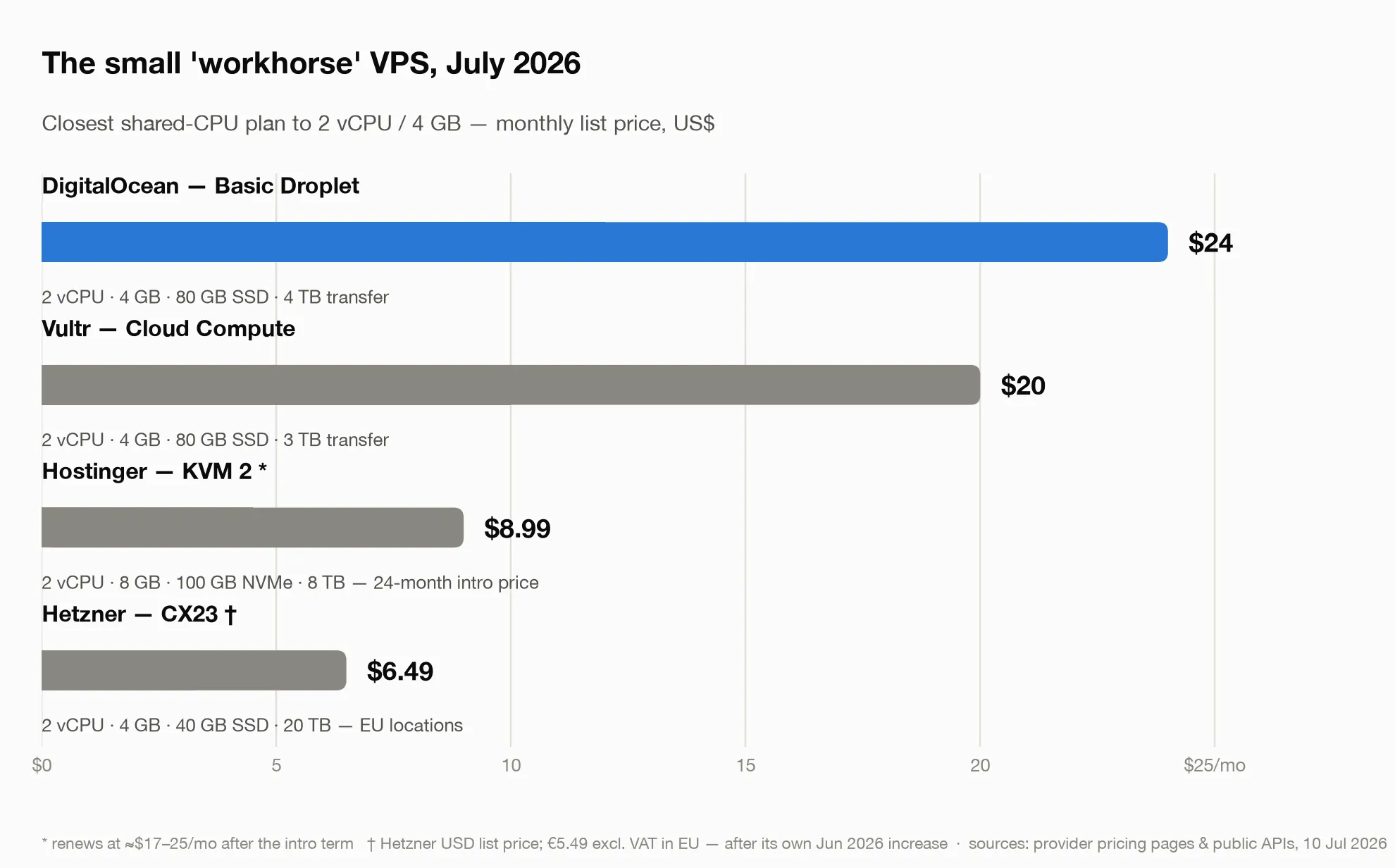
The same shape of machine, four bills. Hostinger’s price is a 24-month intro rate (renews at roughly $17–25); Hetzner’s is its USD list price — €5.49 before VAT in EU locations — after Hetzner’s own June 2026 increase. Sources: provider pricing pages and public APIs, 10 July 2026.
The $24 Basic Droplet ships 80 GB SSD and 4 TB of transfer. Hetzner’s CX23 ships the same cores and RAM with 20 TB of transfer for about a quarter of the price. Vultr’s identical-shape plan is $20. Egress overage on DigitalOcean runs $0.01/GiB — roughly $10 per extra TB versus Hetzner’s ~€1.
If you’re a DigitalOcean customer of long standing, the first honest step is seeing what you actually rent. The API will tell you (doctl is DO’s official CLI):
# Every size slug with its specs and monthly price, straight from DO
doctl compute size list --format Slug,VCPUs,Memory,Disk,PriceMonthly
Then compare what your slugs cost against the chart above. That ten-minute audit is how most people discover they’re paying 2019 prices for 2026 compute — the same “un-revisited assumptions” problem I wrote about in the cloud-bill post, wearing a different logo.
Where the freelancers actually went
Watching this community for the past couple of years — and having moved client workloads myself — the exodus sorted itself into five destinations.
Hetzner: the value king, with a fresh asterisk
The German provider became the enthusiast default from about 2023: absurd specs per euro, 20 TB of included traffic in EU locations, real hardware. The asterisk is new and important: Hetzner raised cloud prices twice in 2026 — in April, and then again on 15 June, when its shared Intel line went from €3.99 to €5.49 and dedicated-vCPU plans more than doubled (CCX13: €15.99 → €42.99). Existing instances keep their price; new orders pay the new one.
Even after the hikes, the CX23 at €5.49 embarrasses a $24 droplet. But the lesson generalizes: the cheap provider will also raise prices eventually. Loyalty is not a strategy; portability is.
# Hetzner's CLI — a CX23 in Falkenstein, Ubuntu 24.04
hcloud server create --name app-01 --type cx23 --image ubuntu-24.04 --location fsn1
Mind the geography: the famous 20 TB of included traffic applies to EU locations; US and Singapore locations include far less (about 1 TB and 0.5 TB respectively) and carry a different, pricier plan line-up.
Vultr: the like-for-like swap
If you want “DigitalOcean, but cheaper and with more regions” rather than a new philosophy: 32 data centres, a $5 1-GB plan, the 2 vCPU / 4 GB workhorse at $20, no prepay games. The closest drop-in replacement on this list — same mental model, slightly better unit prices, far more locations (including plenty in Asia, which matters from Hong Kong).
Hostinger: the beginner wave
The provider every YouTube sponsor segment sells. The hardware is honestly generous — KVM 2 is 2 vCPU / 8 GB / 100 GB NVMe at $8.99/month — but that price requires a 24-month prepay and renews at roughly $17–25/month. Fine value even at renewal; just do the maths on the renewal price, not the banner price, and set a calendar reminder for month 23.
The Coolify wave: your own Heroku on any of the above
The most interesting shift isn’t a provider — it’s a workflow. Coolify (58,000+ GitHub stars) and Dokploy give you a self-hosted PaaS: push-to-deploy, automatic HTTPS, one dashboard for every client app, on any VPS you own. This is what actually replaced the “$5 droplet + a DO tutorial” culture — the tutorial is now a product.
# On a fresh Ubuntu LTS box (Coolify wants 2 cores / 2 GB / 30 GB minimum — a CX23 fits)
curl -fsSL https://cdn.coollabs.io/coolify/install.sh | sudo bash
A freelancer running six client apps on one €10 Hetzner box behind Coolify is paying less than one DigitalOcean droplet used to cost them. That arithmetic, repeated a few thousand times, is the exodus.
Managed PaaS: for those who never wanted a server
Railway, Render, Fly.io — the “I bill for shipped features, not for patching nginx” option. Costlier per unit of compute, cheaper per unit of attention. The right answer for a subset of freelancers, and the wrong comparison for a raw-VPS price chart, so I’ll leave it at that.
One WordPress site for a client → Hostinger (mind the renewal) or any $5-class VPS. A portfolio of client apps → Coolify on Hetzner or Vultr. A product with real traffic and no ops appetite → a managed PaaS, or honestly, staying on DigitalOcean’s App Platform. There is no single winner — that’s rather the point of leaving a defaults-based decision behind.
If you do leave: the unglamorous migration
For a typical small site the move is an afternoon, not a project.
# 1. Freeze a restorable copy of the old droplet (power off first for consistency)
doctl compute droplet-action snapshot 123456789 --snapshot-name "pre-migration-2026-07"

# 2. Sync the payload to the new box (archive mode, compressed)
rsync -avz /var/www/ root@203.0.113.10:/var/www/
Drop your DNS TTL to 300 the day before, restore the database from a fresh dump (not the filesystem), test on the new IP with an /etc/hosts override, then flip the record. Outbound transfer for the copy counts against your included pool; at $0.01/GiB overage, even a 100 GB move is at most a dollar — the egress ransom that keeps people on the big clouds barely exists here.
The migrations that go wrong don’t fail on rsync — they fail on the forgotten cron job, the Let’s Encrypt renewal, the .env that never left the old box. Diff crontab -l, systemctl list-units --type=service, and your certbot state before you kill the old server, and keep that snapshot for a month.
And if you stay
Staying is defensible: your team knows the console, App Platform plus a managed database is a genuinely tidy bundle, invoices come from a US public company (some clients’ procurement cares), the docs remain excellent, and per-second billing has made bursty CI workloads meaningfully cheaper. The $4 and $6 droplets still exist and are still fine for small things.
Just stay deliberately, at 2026 prices, knowing what the alternatives charge — not out of 2015 gratitude.
The takeaway
Nobody villain-twirled here. A public company followed growth upmarket, then followed it into AI, and each step made sense in a boardroom. But the sum of sensible steps is that the platform which taught freelancers to run servers now literally doesn’t count them in its metrics — and the crowd, rationally, took the skills those tutorials gave them and moved somewhere that still prices for them.
Two habits protect you from every future rerun of this story: keep workloads portable (containers, a deploy layer like Coolify, config in git — moving in an afternoon must stay cheap), and re-audit the bill yearly like any other assumption. Platforms change strategy; your loyalty should be to the arithmetic.
Paying 2019 prices for 2026 compute — or not sure whether your stack could actually move in an afternoon? I do this for a living: email me and I’m happy to look at your setup.
If this was worth your time: follow me on Medium, subscribe or bookmark nam-ai.uk for the next post, and connect on LinkedIn — I enjoy comparing infrastructure notes.