 Nam
Nam
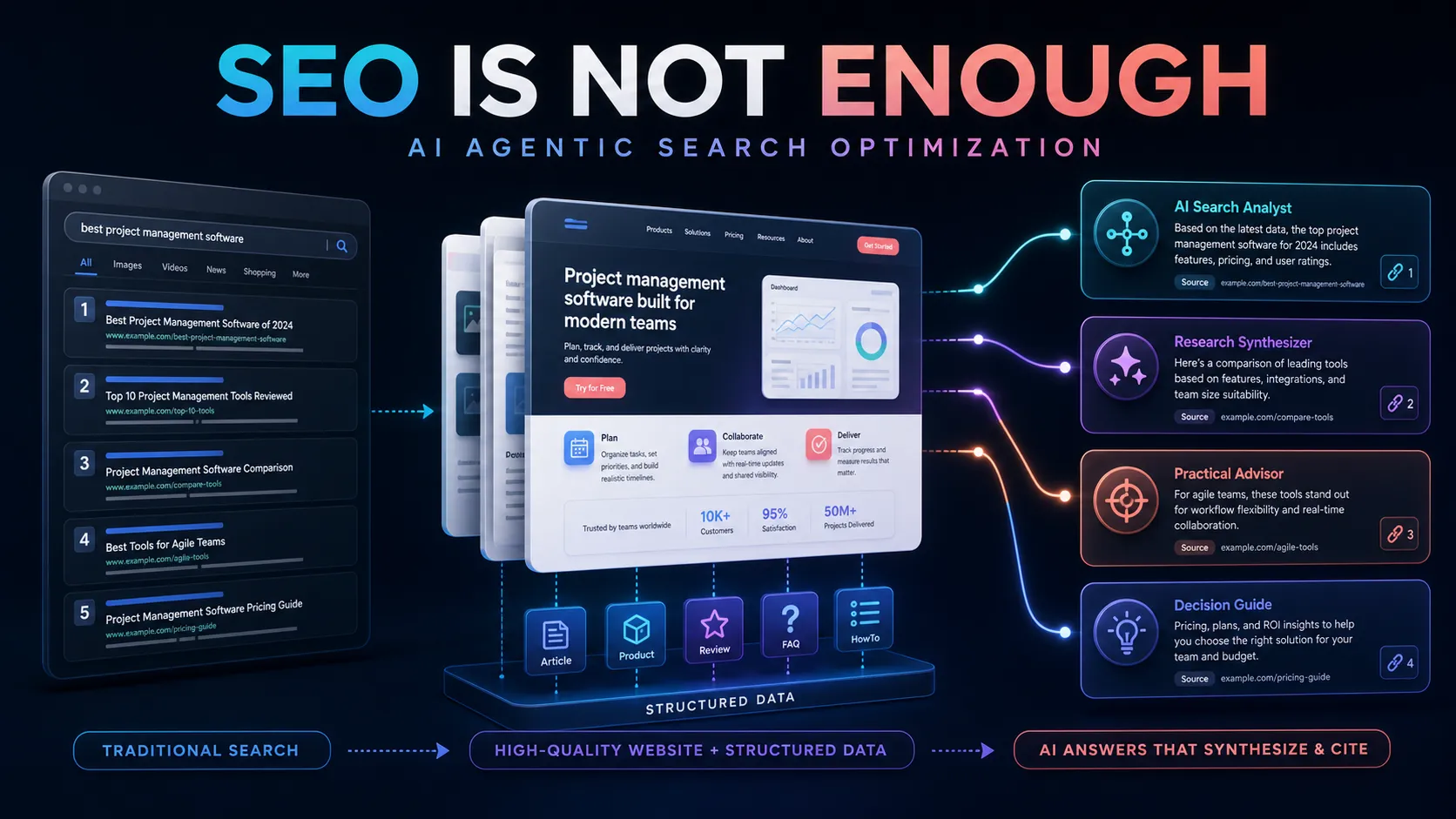
For most of the last twenty years, the job was clear: get a page indexed, rank it for the right keyword, win the click.
That model is not disappearing. But it is no longer the whole search journey.
More people now ask Claude, Grok, ChatGPT or Gemini a complete question and receive a complete answer. The system may search several related queries, open multiple pages, compare claims and return a recommendation with a handful of citations. The user might never see ten blue links. Your page can rank well and still be absent from the answer that shapes the decision.
This changes the unit of visibility. It is no longer only “Did my page rank?” It is also “Did the agent understand my organisation, trust my claim and choose my page as evidence?”
I believe that question will become more important than traditional ranking for many commercial and technical searches. SEO remains the foundation. AI agentic search optimization is the layer being built on top of it.
Table of contents
Open Table of contents
Search is becoming an answer-production system
The platforms do not all work the same way, but their direction is remarkably consistent.
- OpenAI says public sites can appear in ChatGPT search and tells publishers not to block
OAI-SearchBotif they want content included in summaries and snippets. - Anthropic documents separate roles for
Claude-SearchBotand the user-triggeredClaude-User; blocking them can reduce visibility in Claude’s search results. - Google explains that AI Overviews and AI Mode can use “query fan-out”: multiple searches across subtopics and data sources, assembled into one response with supporting links.
- xAI’s documentation describes Grok’s web-search tool as searching in real time, browsing pages, extracting information and returning citations.
In other words, a search result is increasingly not a destination. It is raw material for an answer.
Traditional SEO asks whether a crawler can index a page and whether an algorithm should rank it. Agentic search adds more questions: Can a model isolate the exact answer? Can it resolve who made the claim? Is the claim current? Is it supported elsewhere? Is this the best source to cite for this part of the response?
That is why this cannot sit with the marketing team alone.

The content strategy and the technical delivery are now one system. A brilliant answer hidden behind poor rendering is invisible; perfect schema wrapped around generic copy is not worth citing.
Marketers understand the questions, language, objections and proof a buyer needs. Developers control rendering, crawl access, semantics, performance and structured data. If those two plans are written separately, the website will be optimized for yesterday’s search box.
Three aspects of AI search optimization
There will be a much deeper playbook, but I would start with three layers: access, clarity and authority.
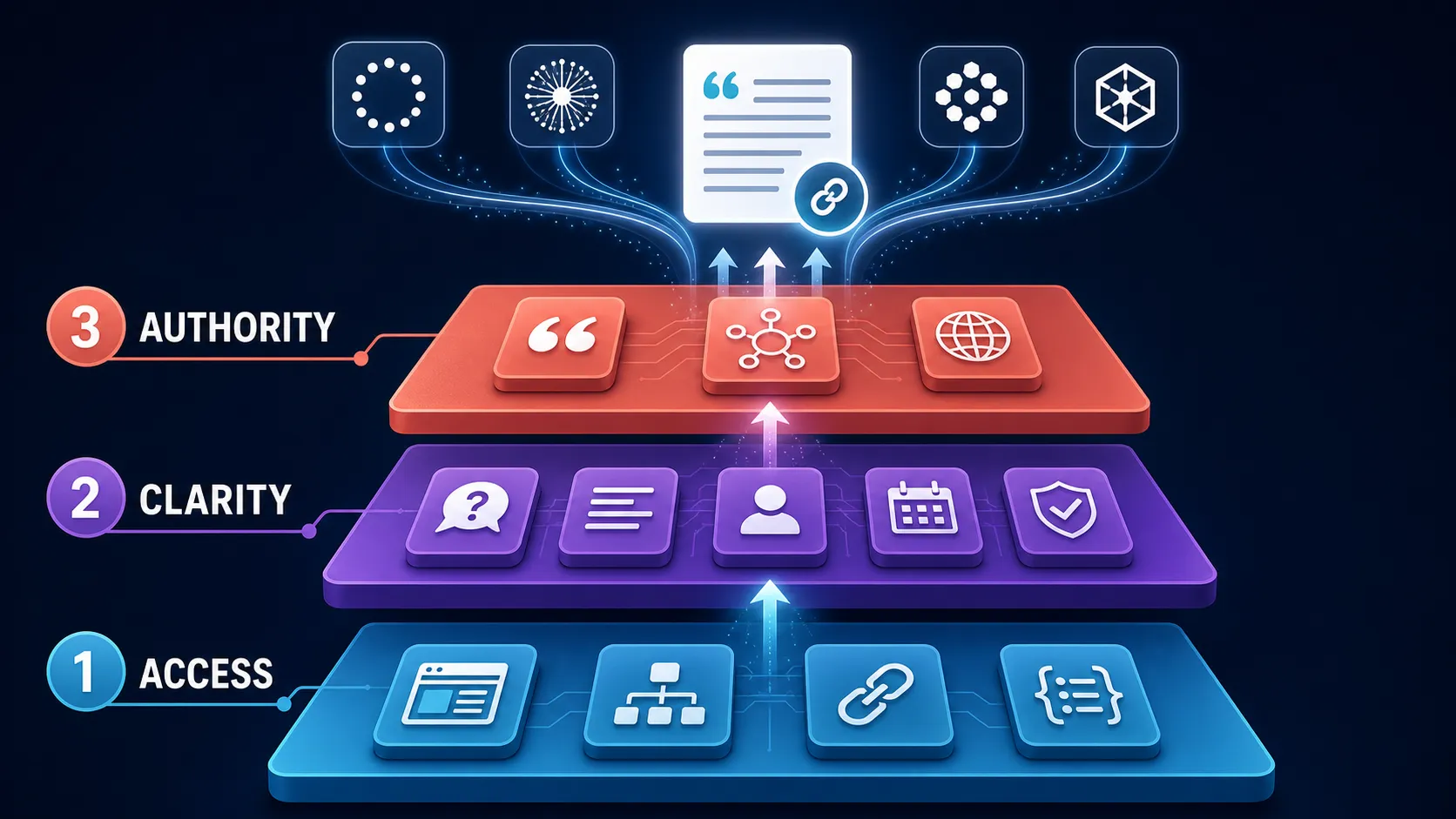
An AI system cannot cite what it cannot access, cannot trust what it cannot understand, and has little reason to choose a source that offers no authority or original value.
1. Access: make the real content reachable
The first job is unglamorous: make sure search systems can actually fetch the page you want them to use.
Audit more than robots.txt. Check the CDN, web application firewall, bot protection, redirects, canonical tags, HTTP status, internal links and JavaScript rendering. Important claims should exist as real text in the delivered page, not only inside an image, animation or interaction that appears after several client-side steps.
If you want visibility in AI search, review access for the relevant search bots. A simplified policy might include:
User-agent: OAI-SearchBot
Allow: /

User-agent: Claude-SearchBot
Allow: /

User-agent: Claude-User
Allow: /
This is illustrative, not a universal file to paste blindly. A site that already allows User-agent: * may not need explicit entries, and organisations may make different choices about search, user retrieval and model training. The important part is to make those choices deliberately—and to avoid accidentally blocking search at the CDN after allowing it in robots.txt.
Accessibility matters too. OpenAI specifically notes that clear ARIA roles, labels and states help its browser agent interpret interactive elements. Semantic HTML that helps a screen reader also gives an agent a cleaner map of the page.
llms.txtIt may be useful for services that choose to read it, but it is not a magic ranking file. Google explicitly says no new AI text file or special schema is required for its AI features. Fix crawlability, internal linking, rendered text and page structure first.
The marketer’s job: decide which content must be public and usable in an answer.
The developer’s job: prove that crawlers and user-directed agents can reach, render and interpret it.
2. Clarity: write answer-ready facts, not keyword fog
A page written to repeat a phrase is not necessarily a page an agent can quote confidently.
Start with the real questions customers ask. Give each important question a direct, self-contained answer before expanding into nuance. Use descriptive headings. Name the product, company, person and location consistently. Show who wrote the page, when it was published, when it changed and what evidence supports its claims.
For a service page, that could mean clearly stating:
- what the service does and does not do;
- who it is designed for;
- the geography or constraints it covers;
- how the process works;
- what proof, methodology or experience supports the promise.
Then make the same meaning explicit in the page structure. Use the appropriate Article, Person, Organization, Product or other schema.org types where they genuinely describe visible content. Structured data should clarify the page, not invent facts that users cannot see.
Google’s advice is refreshingly boring: structured data must match the visible text, and there is no special AI-only schema. That is exactly the point. Clarity beats novelty.
One practical review question is: if an agent extracted only this section, would the answer still identify the subject, scope, evidence and date correctly? If not, the section is probably too dependent on marketing context or clever phrasing.
The marketer’s job: build the question map and write precise, useful answers.
The developer’s job: preserve that meaning in semantic HTML, metadata and structured data.
3. Authority: publish something worth citing
Access gets you considered. Clarity helps you get understood. Neither gives an answer engine a reason to choose you over twenty pages saying the same thing.
The strongest material is usually the hardest to commoditize:
- original data, benchmarks or screenshots;
- a named method that someone has actually used;
- first-hand implementation details and constraints;
- case studies with a measurable before and after;
- expert opinion tied to a real identity and track record;
- primary sources linked beside the claim they support.
This is where traditional authority signals and AI citation value meet. Earn relevant references from other credible sites. Keep the organisation, author and product identities consistent across your site and public profiles. Maintain stable URLs. Correct old claims instead of endlessly producing near-duplicate pages.
An agent assembling an answer needs evidence it can attribute. Give it a clean claim, the proof behind it and a reason to believe you are close to the subject.
Measurement must change as well. Keep Search Console and conventional SEO reporting, but add AI referrals, cited pages, assisted conversions and a repeatable set of real customer questions tested across ChatGPT, Claude, Gemini and Grok. OpenAI already adds utm_source=chatgpt.com to ChatGPT search referral URLs. Google currently includes its AI-feature traffic inside the broader Web search reporting, so no single dashboard will tell the whole story.
These systems, indexes and retrieval methods will keep changing. Build a source that is technically accessible, semantically clear and genuinely authoritative. That survives model updates better than chasing today’s prompt trick.
SEO becomes the foundation, not the finish line
I am not declaring SEO dead. Quite the opposite: a page that is blocked, slow, duplicated, poorly linked or unindexable will struggle in both worlds. Titles, internal links, technical hygiene, useful content and earned authority still matter.
But the end goal is moving.
The old optimization target was a position on a results page. The new target is a place inside a generated answer—and, eventually, inside an agent’s action plan. An agent may research, compare, shortlist and recommend before a human visits a website. When that becomes normal, being the clearest trusted source in the reasoning chain will matter more than being link number three for one exact keyword.
That is why marketers and developers should plan this together now:
- Access: can the relevant systems reach and interpret the content?
- Clarity: can they extract an accurate answer with the right entity, scope and date?
- Authority: is the answer original and credible enough to cite?
This is only the first layer. In future posts I will go deeper into crawler audits, entity and structured-data design, answer-ready content architecture, and how to measure visibility when the result is a citation rather than a ranking.
The brands that start learning this now will not abandon SEO. They will turn it into infrastructure for the next search interface.
If you are planning how your website should be understood—not merely ranked—by AI agents, this is exactly the kind of content-and-engineering problem we work on at Wistkey. Email me and I will give you a practical starting point.
If this gave you a useful framework, follow me on Medium, subscribe or bookmark nam-ai.uk for the deeper follow-ups, and connect on LinkedIn—I would love to hear what AI search is already changing for your team.